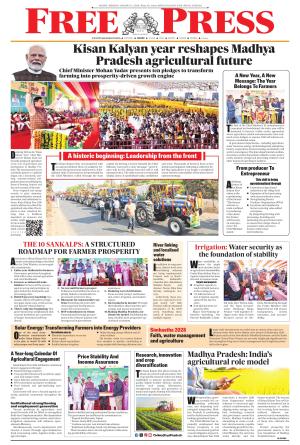
INDORE | MONDAY | JANUARY 12, 2026 | Regd. No. Indore MP/ICD 216/2024-2026 | RNI No. 38281/83 FREE www.freepressjournal.in ESTD-1983 iii QUALITY @ VALUE EDITIONS: INDORE UJJAIN PRESS PUNE BHOPAL NASHIK MUMBAI E-paper Kisan Kalyan year reshapes Madhya Pradesh agricultural future Chief Minister Mohan Yadav presents ten pledges to transform farming into prosperity-driven growth engine A New Year, A New Message: The Year Belongs To Farmers T D eclaring 2026 as the “Kisan Kalyan Year”, Chief Minister Dr Mohan Yadav has formally positioned agriculture at the core of governance and development in Madhya Pradesh. The announcement is not a symbolic gesture or a political slogan, but a structured, yearlong, outcome-oriented programme aimed at redefining the future of farming, farmers, and the rural economy of the state. From irrigation and energy security to price assurance, agro-industrialisation, research, innovation, and institutional reforms, Kisan Kalyan Year 2026 seeks to address every link of the agricultural value chain. The objective is clear: transform farming from a livelihood dependent on monsoon and market volatility into a stable, technology-enabled, incomes e c u r e d profession. A he first of the Chief Minister’s 10 commitments is conceptual yet foundational: the entire year will be dedicated to farmers. Unlike earlier approaches where agriculture-related announcements were scattered across budgets or seasons, 2026 will witness continuous, coordinated action. 16 government departments—including agriculture, water resources, energy, rural development, animal husbandry, cooperatives, food processing, and industry will work in convergence. This inter-departmental coordination aims to ensure that policies related to water, power, credit, markets, storage and processing reinforce each other instead of operating in isolation. A historic beginning: Leadership from the front T he Kisan Kalyan Year was launched with an unprecedented show of solidarity between the government and farmers. A disciplined rally of 1,101 tractors, led personally by the Chief Minister, rolled through the state capital. By driving a tractor himself, the Chief Minister conveyed a clear message—governance will not be distant from the soil; it will emerge from it. The rally was not a ceremonial display alone. It symbolised unity, confidence From producer To Entrepreneur A defining feature of the Kisan Kalyan Year vision is the repositioning of the farmer. “The farmer will not remain confined to producing crops alone; the farmer will become an entrepreneur,” the Chief Minister stated. THE 10 SANKALPS: A STRUCTURED ROADMAP FOR FARMER PROSPERITY t the heart of Kisan Kalyan Year are 10 clearly articulated pledges, described by the Chief Minister as non-negotiable commitments. 1. Entire year dedicated to farmers: Governance priorities throughout 2026 will revolve around agriculture and rural livelihoods. 2. Farmers as industrial stakeholders: Farmers will be encouraged to set up and participate in agro-industries, food parks, and processing units. 3. Relief from every hardship: Systematic efforts will address irrigation gaps, input costs, credit access, and disaster-related distress. 4. This is only the beginning: The government has emphasised that current initiatives are a preview of larger structural reforms ahead. and trust. Thousands of farmers from across districts participated, reflecting a collective belief that agriculture is no longer a peripheral sector but the central pillar of the state’s development strategy. River linking and localised water solutions I 5. No rest until farmers prosper: Political accountability has been explicitly linked to measurable improvement in farmers’ lives. 6. Bhavantar for mustard after soybean: Extending the price deficiency payment mechanism to ensure fair remuneration. 7. MSP commitment on wheat: Demonstrated through procurement at Rs 2,700 per quintal, reinforcing trust in government assurances. 8. Reducing cost of cultivation: Focus on solar pumps, mechanisation, micro-irrigation, and modern inputs. 9. Increasing farm income: Through diversification, allied activities, processing, and export promotion. 10. Making Madhya Pradesh a national role model: Establishing the state as India’s most progressive agricultural ecosystem. Solar Energy: Transforming Farmers into Energy Providers O ne of the most transThis initiative aims to: formative commitments n Eliminate dependence on erratic under Kisan Kalyan Year power supply is the plan to install 30 lakh n Reduce diesel expenditure solar pumps over three years. n Enable daytime irrigation A Year-long Calendar Of Agricultural Engagement Kisan Kalyan Year 2026 will feature continuous farmer engagement through: n Natural farming conclaves n Crop-specific festivals such as soybean, sugarcane, and mango events n Dairy, fisheries, and horticulture conferences n FPO conventions and export workshops n Food festivals and agri-marketing symposiums Each month will carry a focused agenda, ensuring sustained momentum throughout the year. n Make farming energy-efficient and climate-resilient The broader vision is to convert farmers from annadata to urjadata, contributing to energy surplus while lowering cultivation costs. Price Stability And Income Assurance Research, innovation and crop diversification n Promotion of agro-based industries at the village level n Expansion of food processing units near production zones n Strengthening Farmer Producer Organisations (FPOs) n Incentives and subsidies for farmers entering value-added enterprises By integrating farming with processing, branding and marketing, the government aims to ensure that a larger share of consumer value accrues to farmers rather than intermediaries. Irrigation: Water security as the foundation of stability W ater availability remains the single most decisive factor in agricultural sustainability. Under Kisan Kalyan Year, irrigation expansion has been elevated to mission mode. Targets and progress n Irrigation capacity to reach 100 lakh hectares in the coming years n 7.31 lakh hectares of new irrigation capacity added in the last two years n 8.44 lakh hectares targeted by 2026 Major river-linking initiatives—including the Parvati–Kalisindh–Cham- Simhastha 2028 Faith, water management and agriculture bal Link, Ken–Betwa Link, and the Tapti Groundwater Recharge Mega Project—will together irrigate more than 16 lakh hectares across 25 dis- tricts. Monitoring through the Prime Minister Gati Shakti Portal will ensure transparency, timely execution, and accountability. L arge-scale investments are underway to ensure clean and continuous water flow in the Shipra river ahead of Simhastha 2028. Projects such as the Severkhedi–Silarkhedi scheme and the Kanh Diversion Closed Duct Project are not only religiously significant but also strengthen long-term water management and irrigation potential in the region. Madhya Pradesh: India’s agricultural role model T he Kisan Kalyan Year places strong emphasis on research and innovation. New crop-specific research centres are being established to improve productivity and quality. Digital weather advisory systems, modern seed testing laboratories, strengthened mandis, and promotion of natural and organic farming will collectively modernise agricultural practices. Institutional strengthening and employment generation Vacant positions in agriculture and mandi boards will be filled to strengthen field-level implementation. Mechanisation support, custom hiring centres, and microirrigation expansion will enhance operational efficiency. Simultaneously, rural employment will receive a boost through agro-industries, food processing units, logistics hubs, and agri-startups. n addition to mega projects, district-level river interlinking schemes are being implemented. Projects such as Kanh– Gambhir, Kalisindh– Chambal, Ken–Mandakini, Shakkar–Pench, and Jamner–Nevan–Bina have already undergone surveys. Collectively, these projects are expected to irrigate nearly 5.97 lakh hectares with an estimated investment of Rs 9,870 crore, benefiting thousands of farmers across multiple regions. This shift is being operationalised through Market volatility has long undermined farmer confidence. The government has reaffirmed its commitment to: * Expand the Bhavantar Yojana * Ensure timely MSP procurement * Continue zero-per cent interest loan schemes * Implement technology-based crop damage assessment These measures aim to de-risk agriculture while ensuring predictability of income. W ith agriculture growing at nearly 16%, expanding cultivated area, and deepening technological integration, Madhya Pradesh is positioning itself as India’s most forwardlooking agricultural state. The Chief Minister has repeatedly emphasised that farmer prosperity is not merely an economic goal but a moral obligation of governance. Kisan Kalyan Year 2026 represents a decisive shift from fragmented welfare schemes to structural agricultural transformation. By aligning water, energy, markets, technology, research and governance around the farmer, Madhya Pradesh is attempting to create a resilient rural economy capable of sustaining growth for decades. As articulated by the Chief Minister, the soil is the state’s identity and the farmer its pride. The success of Kisan Kalyan Year will ultimately be measured not in announcements or rallies, but in rising farm incomes, reduced distress, empowered rural communities, and the enduring confidence of those who cultivate the land. Farmer prosperity, the government asserts, is the true foundation of Madhya Pradesh’s future. D-16141