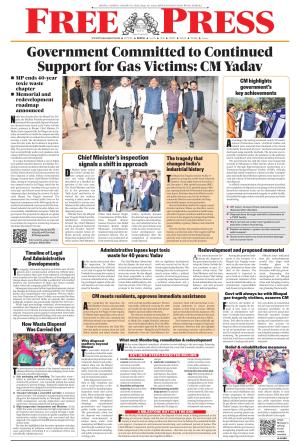
BHOPAL | SUNDAY | JANUARY 18, 2026 | Regd. No. Indore MP/ICD 216/2024-2026 | RNI No. 38281/83 FREE ESTD-1983 iii QUALITY @ VALUE www.freepressjournal.in EDITIONS: BHOPAL UJJAIN PRESS PUNE INDORE NASHIK MUMBAI E-paper Government Committed to Continued Support for Gas Victims: CM Yadav n MP ends 40-year toxic waste chapter n Memorial and redevelopment roadmap announced CM highlights government’s key achievements N early four decades after the Bhopal Gas Tragedy, the Madhya Pradesh government has announced the successful disposal of hazardous chemical waste stored at the Union Carbide factory premises in Bhopal. Chief Minister Dr Mohan Yadav inspected the Arif Nagar site on Saturday and said the air inside the campus was fully clean, allowing him to conduct the review without wearing a mask. The development matters because the toxic waste had remained a long-standing environmental and public health concern since 1984. The government says the disposal was carried out scientifically under court guidance, indicating a shift from prolonged neglect to structured remediation and redevelopment. In a major development linked to one of India’s most painful industrial disasters, the Madhya Pradesh government has declared that the decades-old hazardous chemical waste lying inside the Union Carbide India Limited (UCIL) factory premises has been disposed of safely, without environmental damage or human harm. Chief Minister Dr Mohan Yadav, during an on-ground inspection of the factory campus located in Arif Nagar, stated that the state government is “standing with gas victims at every step” and will now move forward with redevelopment plans, including the creation of a dedicated Bhopal Gas Tragedy memorial. The announcement has renewed public focus on the long-term consequences of the 1984 tragedy, the unresolved environmental concerns around the abandoned industrial site and the broader debate over accountability, rehabilitation and justice. While the government has projected the disposal as a global example of scientific waste management, survivors’ groups and environmental observers are expected to scrutinise the long-term monitoring measures and future planning for the site. https://youtu.be/XB hSmQLw4YI?si=5eK 9YffespcapHzo Cm's visit to union carbide campus. Media Bite. T A D Chief Minister’s inspection signals a shift in approach r Mohan Yadav visited the Union Carbide factory campus and carried out what officials described as a detailed inspection of the core area. The Chief Minister said the air in the premises was “fully clean” and that he reviewed the site without wearing a safety mask—an act intended to convey confidence in the safety status of the campus after the waste disposal process. Officials from the Bhopal Gas Tragedy Relief and Rehabilitation Department briefed the Chief Minister on the proposed memorial and the broader redevelopment concept. Senior officials present during the inspection included the Secretary to the Chief Minister’s Timeline of Legal And Administrative Developments he tragedy’s aftermath included criminal cases, investigations and a compensation settlement. Official timelines mention that cases were registered, investigations were transferred to the Central Bureau of Investigation and charge sheets were filed. In 1989, a settlement was reached between the Government of India and Union Carbide, under which the company paid $470 million. Subsequent years saw further legal developments, including changes in charges and continued debate over whether justice and compensation were adequate. Warren Anderson, then Chairman of Union Carbide, was arrested but later released on bail and left India, an episode that remains politically sensitive and emotionally charged for survivors. While legal proceedings continued, environmental remediation and disposal of toxic waste remained slow and contested. Government documentation indicates that significant structured action gained momentum years later, with provisions for disposal funding, trial runs, and tendering processes leading up to final disposal in 2025. How Waste Disposal Was Carried Out T Office Alok Kumar Singh, Commissioner Public Relations Deepak Kumar Saxena, Director Gas Relief Swatantra Kumar Singh, Municipal Commissioner Sanskruti Jain and other department officers. The inspection was positioned as both symbolic and adminis- I n his media interaction after the inspection, Dr Mohan Yadav described the 1984 leak as not only a tragedy for Madhya Pradesh but among the country’s worst disasters. He also criticised previous administrations, alleging prolonged neglect of the site and inaction on toxic waste disposal for decades. T trative, symbolic because the site has long represented the tragedy’s unresolved legacy, and administrative because the government now seeks to move toward structured development and memorialisation after the completion of hazardous waste disposal. he Bhopal Gas Tragedy remains widely regarded as among the world’s worst industrial disasters. On the night between December 2 and December 3, 1984, methyl isocyanate (MIC) gas leaked from the UCIL pesticide plant in Bhopal, exposing hundreds of thousands of people to toxic fumes. Estimates shared in official records and public discourse vary, but the incident is commonly linked to mass casualties and longterm health impacts across generations. Beyond immediate deaths, the tragedy caused chronic respiratory illness, eye disorders, neurological complications, reproductive health issues, and other long-term medical conditions among survivors. It also triggered prolonged legal battles, political controversy, and global debate on corporate liability, regulatory failures, and industrial safety. Over the decades, the abandoned factory site became a symbol not only of the tragedy itself but also of the unresolved environmental hazard posed by toxic waste and contaminated soil and groundwater in and around the premises. The Chief Minister claimed that after the disaster, the area was effectively left unattended and that no firm decisions were taken to remove toxic waste. He also alleged that those responsible in earlier periods enabled Warren Anderson to leave India. Additionally, he criticised the period of the UPA government at the Centre, claiming A fter completing the inspection, the Chief Minister’s convoy was reportedly stopped by a woman performing a prayer ritual in Arif Nagar. On her request, Dr Mohan Yadav paused his convoy and offered incense at a Shiv idol, a moment that officials portrayed as an expression of local connection and humility. During the interaction, the Chief Minister also spoke to women about the Ladli Behna scheme and asked whether they that no significant development work was carried out for the affected region during that time. This framing places the current government’s actions within a political narrative of corrective governance —projecting waste disposal as both a technical achievement and a moral response to historical negligence. he successful disposal of hazardous industrial waste from the UCIL premises has implications beyond local redevelopment. Experts and policymakers often cite the Bhopal tragedy in debates on industrial safety, corporate accountability, hazardous waste management and environmental justice. If the disposal process is verified as fully compliant and safe, it could become a reference model for handling legacy hazardous waste sites across India. Many industrial regions face similar challenges—abandoned plants, unregulated dumping, contaminated groundwater and long-term public health consequences. The government’s claim that the disposal was conducted without environmental or human harm, under strict monitoring, will likely be evaluated through continued reporting, environmental sampling, and public transparency in the coming years. were receiving monthly assistance. Women reportedly confirmed receiving Rs 1,500 per month. He also interacted with schoolchildren and took selfies with them. The visit also included an immediate relief decision when a local woman, identified as Manju Bai, sought financial assistance due to her husband’s illness. The Chief Minister reportedly approved Rs 50,000 each for two women—Manju Bai and Prabha Bai Kushwaha—from the Chief Minister’s dis- n 337 metric tonnes of toxic chemical waste disposed after decades n Disposal done through scientific incineration at a TSDF facility n Work carried out under court guidance and pollution-control monitoring n Sealed containers + green corridor ensured safe transport n Government claims no environmental damage and no human harm Redevelopment and proposed memorial A key announcement following the disposal is the government’s plan to develop the Union Carbide factory premises as part of a broader urban vision. The Chief Minister said the state will move ahead “after taking all sections of society and affected stakeholders into confidence,” and will proceed under judicial guidance. CM meets residents, approves immediate assistance Why disposal matters beyond Bhopal he government’s description of the disposal operation emphasises three key components: safe packaging, secure transport and controlled destruction. 1) Safe packaging and handling: The hazardous waste— linked to pesticide manufacturing residues and related chemical by-products—was reportedly packed into sealed containers to prevent leakage. Authorities stated that handling protocols were designed to avoid direct exposure and ensure containment during movement. 2) Transport through a controlled corridor: A dedicated “green corridor” was created for transporting the waste from Bhopal to the disposal facility in Pithampur. This involved traffic management, security deployment and technical supervision, ensuring minimal risk during transit. 3) High-temperature incineration and filtration: At the TSDF, the waste was incinerated at high temperatures. The government said emissions were passed through a multistage filtration system to ensure air quality compliance. Postincineration residue, including ash, was tested and then disposed of in engineered landfill systems designed for hazardous waste. The state has highlighted that the entire operation took place under monitoring by pollution control authorities and under court supervision, presenting it as a compliance-driven and scientifically validated process. The tragedy that changed India’s industrial history Administrative lapses kept toxic waste for 40 years: Yadav T ccording to the state government, nearly 337 metric tonnes of hazardous waste—chemical residue and related toxic material that remained at the closed UCIL facility for around 40 years—has been removed and destroyed using scientific methods. The process was reportedly conducted under the guidance of the judiciary and in compliance with environmental safety protocols. The government has said the waste was transported securely to Pithampur in Dhar district, where it was disposed of through high-temperature incineration at a Treatment-Storage-Disposal Facility (TSDF). Officials stated that sealed containers, a “green corridor” transport plan and multi-layer filtration systems were used to prevent any release of harmful pollutants during transport and disposal. In official communication, the government described the completion of disposal as a message to the world that hazardous industrial waste can be eliminated without compromising environmental integrity or public health, if handled through modern scientific processes and strict monitoring. cretionary fund, with instructions to municipal authorities to ensure prompt transfer to their bank accounts. Officials said an immediate interim assistance of Rs 10,000 each would be provided on the same day, with the remaining amount to follow. Such moments are often politically significant, reinforcing an image of responsive governance. However, they also highlight the continuing economic vulnerability of many families living in the affected areas. What next: Monitoring, remediation & redevelopment W ith the waste disposal completed, attention is now shifting to the next stage: Ensuring that the site remains safe and is redeveloped in a way that is socially sensitive, environmentally sound, and historically respectful. Among the proposed initiatives is the creation of a Bhopal Gas Tragedy memorial on the now-clean campus, dedicated to those who died in the disaster. The memorial is expected to serve both as a tribute and a permanent reminder of the need for industrial safety, environmental responsibility and disaster preparedness. Officials have indicated that the redevelopment would also align with broader plans to strengthen urban infrastructure, with the government discussing the development of Bhopal and Indore as metropolitan cities and bringing nearby districts into a metropolitan planning framework. Govt will always be with Bhopal gas tragedy victims, assures CM F or survivors and families affected by the tragedy, the disposal of toxic waste is not merely an administrative milestone—it is deeply tied to questions of health, dignity and long-delayed closure. Even after the waste is removed, concerns remain about the long-term effects of contamination on soil and groundwater and the need for sustained environmental monitoring. The government has stated that it will focus on scientific assessment of underground pollu- tion, remediation of contaminated soil and water and long-term environmental surveillance. At the same time, survivors’ groups have historically demanded stronger healthcare support, transparent reporting and comprehensive rehabilitation that accounts for intergenerational health impacts. The renewed attention on the site may bring fresh scrutiny to whether healthcare facilities and compensation mechanisms are adequate and responsive. Relief & rehabilitation measures KEY NEXT STEPS EXPECTED INCLUDE 1) Scientific environmental assessment: Authorities have indicated a focus on scientific evaluation of underground contamination, including soil and groundwater testing. This is critical because even after waste removal, chemical pollutants may remain in the environment. 2) Remediation and long-term monitoring: Remediation efforts could involve soil treatment, groundwater purification, and periodic environmental audits. Long-term monitoring will be essential to build public confidence and ensure no secondary risk F emerges. 3) Stakeholder consultations: The government has said it will consult affected groups and stakeholders before finalising redevelopment. This could include survivors’ organisations, public health experts, urban planners, environmental scientists, and local residents. 4) Memorial planning and public design process: The proposed memorial could evolve into a larger museum and educational space documenting the tragedy, the aftermath, and lessons for industrial safety. The design and narrative framing will matter— whether it prioritises remembrance, justice, education, or redevelopment messaging. 5) Integration into urban planning: With metropolitan development plans being discussed for Bhopal and surrounding districts, the Union Carbide site could be integrated into a wider urban renewal framework. This raises questions about land use, public access, green space planning, heritage preservation, and the balance between development and memory. A MILESTONE BUT NOT THE END or the Madhya Pradesh government, the disposal of toxic waste is being presented as the closing of a 40-year chapter and the start of a redevelopment phase. For survivors and civil society, it may be seen as a long-overdue step that must now be followed by sustained healthcare support, transparent environmental monitoring, and continued pursuit of justice. The Chief Minister’s inspection and the government’s announcements have placed the Union Carbide campus back at the centre of public discussion—this time not only as a site of tragedy, but as a test case for how India handles industrial legacy hazards, environmental remediation, and the human costs of corporate and regulatory failure. T he Gas Tragedy Relief and Rehabilitation Department continues to run social rehabilitation and welfare programmes for affected families. Among the measures highlighted is additional pension support for gas-affected widows under the “Kalyani” category. According to government figures, 4,334 gas-affected widows are receiving pension support, including an additional amount of Rs 1,000 per month paid through the gas relief department, apart from social security pension provisions. Officials also claim the government is strengthening hospitals and health centres for long-term disease monitoring, supporting research into gen- erational impacts, and linking widows, persons with disabilities, and severely affected families to social security schemes. While these initiatives are presented as ongoing support, public expectations remain high for transparent delivery, grievance redress mechanisms, and medical infrastructure upgrades, particularly in neighbourhoods historically affected by the tragedy. Chief Minister’s official social media handles D-16150